
A few green stalks in a simple vase can carry a surprisingly rich story. Lucky bamboo is associated with good fortune, thoughtful gifts, and welcoming homes. But its botanical roots and its cultural associations come from different parts of the world.
To understand its history, it helps to separate three things: the plant itself, the bamboo it resembles, and the meanings people give it.
An African plant with a familiar name
Lucky bamboo, commonly known botanically as Dracaena sanderiana, is native to tropical Africa. North Carolina State Extension describes it as a tropical perennial shrub from West Africa, with its native range extending through west-central tropical Africa to northeastern Angola.
Despite its common name, it is not a true bamboo. Lucky bamboo belongs to the asparagus family, Asparagaceae. Its green, jointed stems give it a bamboo-like appearance, which helps explain why the name feels so fitting.
That distinction is an important part of its story: a plant can have strong cultural associations with a place without being native to that place.
The story behind its botanical name
The name sanderiana commemorates Henry Frederick Conrad Sander, a German-born nurseryman and orchid specialist based in St. Albans, England. It is a reminder that familiar houseplant names often preserve connections to people in horticulture.
Other common names include friendship bamboo, ribbon plant, and Chinese water bamboo. These names emphasize different aspects of its identity, from its appearance to its role as a gift.
Why is it considered lucky?
Lucky bamboo is associated with Chinese symbolism and is used in feng shui, a tradition concerned with the arrangement of spaces and the flow of energy, or chi. In that setting, the plant can serve as a symbol of good fortune, harmony, and prosperity.
Its bamboo-like appearance links it with the symbolism surrounding true bamboo. However, the cultural history of bamboo should not be treated as an exact timeline for this African Dracaena. Popular claims of a precise, thousands-of-years-long history for lucky bamboo itself should be approached cautiously.
Its meaning is best understood as symbolism and tradition, not a promise that a plant can produce wealth or change someone's fortune.
What do the stalk numbers mean?
Part of lucky bamboo's appeal is the idea that an arrangement can carry a particular wish for its recipient. Clemson Cooperative Extension describes these associations:
- One stalk: Good fortune.
- Two stalks: Love and relationships.
- Three stalks: Happiness.
- Five stalks: Health.
- Six stalks: Prosperity.
Interpretations vary across sources and traditions, so these meanings are not a universal rulebook. Four-stalk arrangements are often avoided in luck-themed gifting because four is considered unlucky in this context.
If you are choosing an arrangement for someone, the personal message matters just as much as the number of stalks. A note such as “Wishing you happiness in your new home” makes the intention clear.
From symbolic arrangement to modern houseplant
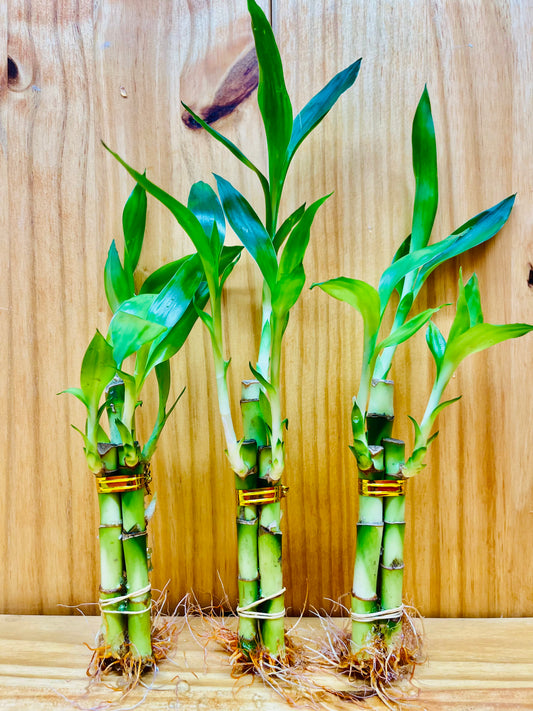
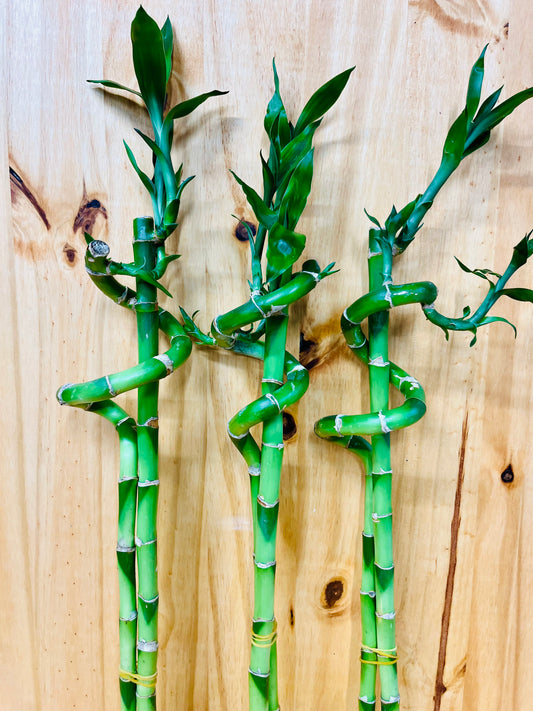
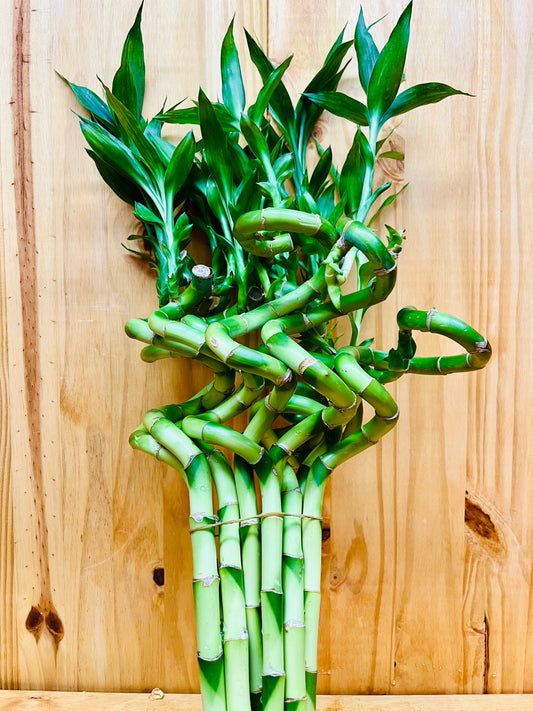
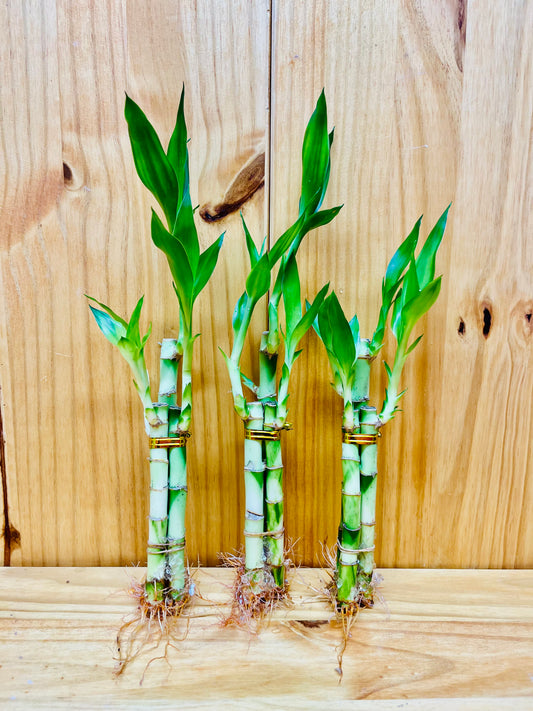
Lucky bamboo brings together ornamental horticulture, cultural symbolism, and gift-giving. Arrangements range from a single upright stalk to grouped stems and carefully trained shapes. North Carolina State Extension notes that growers train the stems into a variety of forms.
University of Arkansas Extension describes its popularity as a meeting of Eastern symbolism, Western interest in feng shui, and commercial horticulture. Rather than a single origin story, its modern identity reflects several influences coming together.
Today, it can be appreciated both as a living decoration and as a gesture of goodwill. It is often given for celebrations such as Chinese New Year, and its hopeful symbolism also makes it a thoughtful choice for a new home, a workspace, or a fresh start.
A meaningful gift, without the mythology
You do not need to practice feng shui to enjoy lucky bamboo. For some people, it represents prosperity or harmony. For others, it is a reminder of the friend who gave it to them, or simply a welcome touch of green.
Its most interesting story is the real one: an African tropical plant, a resemblance to bamboo, a botanical name honoring a nurseryman, and cultural meanings that have helped make it a recognizable gift plant.
However you interpret its symbolism, lucky bamboo offers a lovely way to say, “I wish you well.”